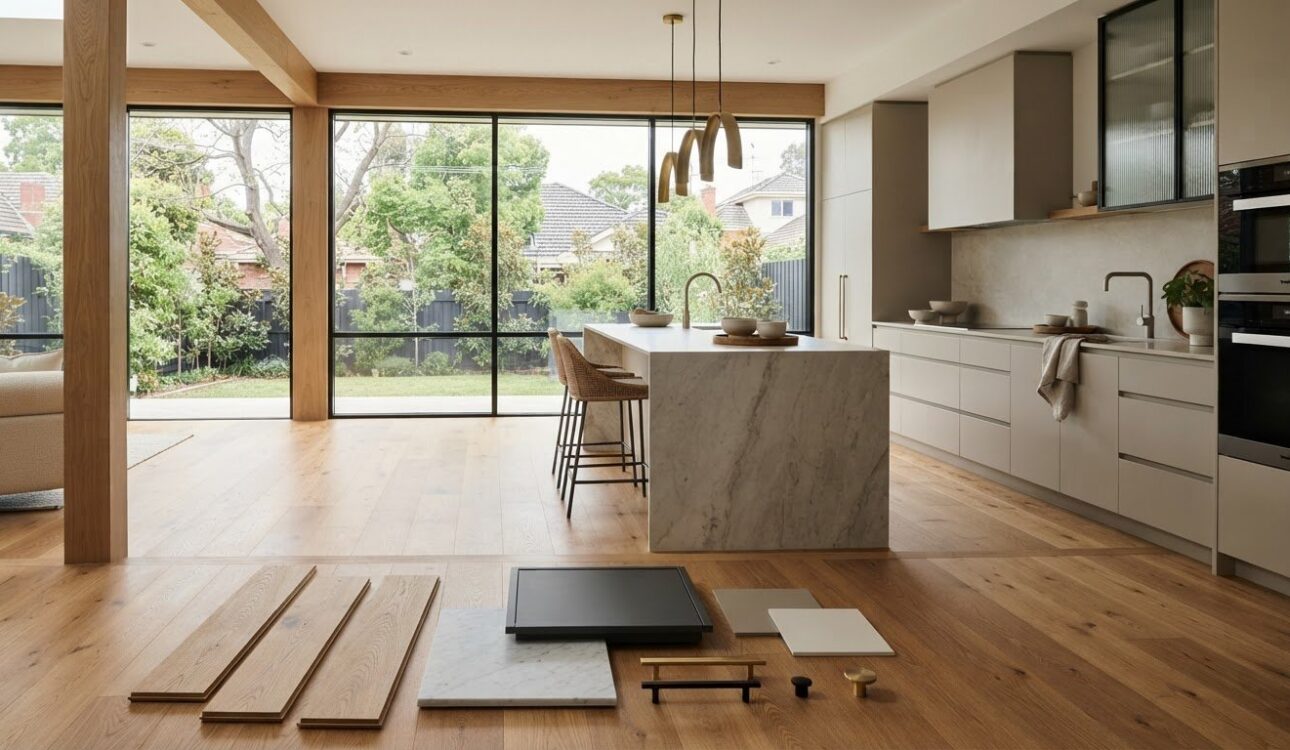
What if the oak sample you love looks different beside your cabinetry at home? Warm oak flooring can add natural depth and a welcoming feel to a Melbourne kitchen, but its appearance can change with the light and surrounding finishes. Before choosing, compare it with your walls, benchtop and furniture, and decide whether a real timber floor or an oak-look option better suits your project.
Consider tone, finish and flooring construction together rather than choosing by colour alone. This guide explains how to assess samples in your room, compare real oak with oak-look options, and check product details before making a decision.
You’ll also learn how to plan flooring alongside cabinetry and other kitchen renovation choices for a cohesive result. From natural light to surface character, each detail can help shape a kitchen that feels considered and distinctly yours.
Key Takeaways
- Warm oak describes a look, not a single flooring construction. Check what the product is made from before comparing options.
- Assess samples in your room and revisit them as daylight changes to see how the tone works with adjoining finishes.
- Compare cabinetry, benchtops, walls and connected spaces together. Decide whether you prefer subtle harmony or intentional contrast.
- Consider warm oak flooring alongside your kitchen renovation choices to help coordinate the overall palette.
- Before deciding, confirm product specifications, suitability, installation requirements and maintenance instructions with the supplier or installer.
What Is Warm Oak Flooring? Understand the Look Before You Choose
Warm oak flooring describes a floor with an oak-inspired appearance and golden, beige or brown visual tones. The phrase alone doesn’t specify its material, construction or finish. That distinction matters when comparing samples for a Melbourne kitchen renovation. Two floors described as warm oak can look similar but be made quite differently.
Think of “warm” as a visual description, not a standardised product specification. Golden or honeyed tones may give a floor a sunlit impression, while beige and brown-leaning tones can appear more muted or earthy. Grain pattern and surface finish also affect the look, so treat colour labels as a starting point for comparison.
Which undertones make an oak floor feel warm?
An undertone is the subtle colour beneath a floor’s main shade. It can make an oak appearance read as golden, softly beige or brown-leaning, and affects how it relates to other colours in the room. Before settling on a tone, place a physical sample beside your paint, cabinetry and furnishings. Compare the whole combination, not the flooring in isolation.
Is warm oak the same as natural oak flooring?
No. Colour appearance and flooring construction are separate choices. “Oak” may describe the timber used in a floor, or the visual effect of another material. A product described as oak-look isn’t proof that it contains genuine oak. Check the product description for the core material, any real-wood layer, finish and construction details.
For a neutral overview of solid and engineered options, see Wood flooring. Use it as background reading, then confirm specific product details with the supplier. Don’t assume a warm colour name tells you whether the floor is solid timber, engineered timber or an oak-look alternative.
In a renovation, knowing the construction helps you coordinate the floor with cabinetry instead of making a colour decision on its own. If cabinetry is part of your plans, explore cabinet-making in Melbourne as you consider the room’s overall palette. Next, assess shortlisted tones in your space and compare them with adjoining finishes.
How to Choose a Warm Oak Flooring Tone for Melbourne Rooms
A sample that looks softly honeyed in a showroom may read differently beside your kitchen cabinetry at home. Melbourne homes vary in orientation, window size and artificial lighting, so there isn’t one oak tone that suits every room. Compare samples in your own space before making a decision.
How should you test warm oak flooring samples at home?
Use this process to assess each option in context:
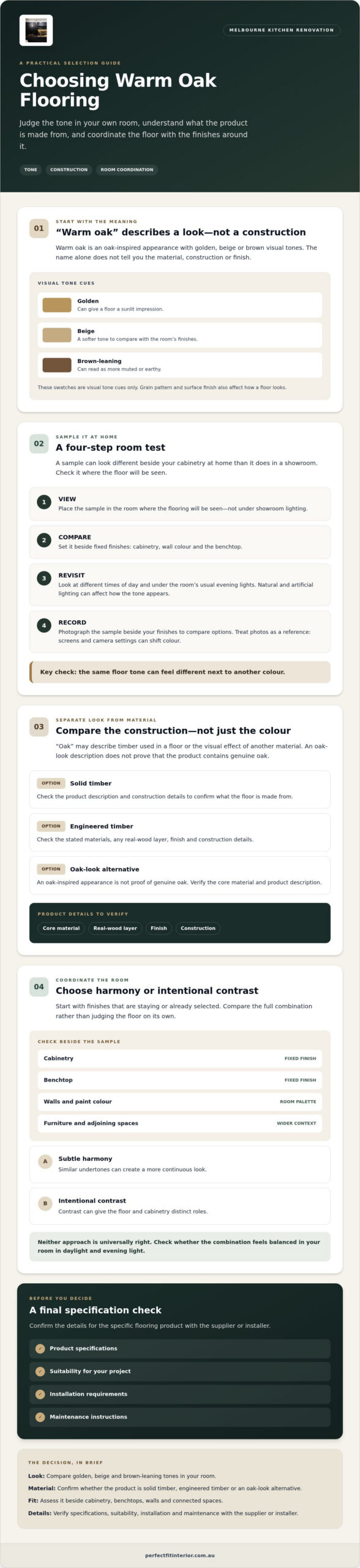
- View: Place the sample where the floor will be seen, rather than judging it under showroom lighting.
- Compare: Set it beside fixed finishes, such as cabinetry, wall colour and the benchtop. This makes undertone differences easier to spot.
- Revisit: Look at different times of day and under the room’s usual evening lights. Orientation and artificial lighting can affect how a tone appears.
- Record: Photograph the sample beside your finishes to compare shortlisted options. Use photos as a reference only, since screens and camera settings may shift colour.
Flooring samples are most useful beside fixed finishes, because the same tone can feel different next to another colour.
Which warm oak shade suits your existing finishes?
Start with finishes that are staying or already selected, especially cabinetry and benchtops, before considering movable décor. Similar undertones can create a more continuous look, while contrast can give the floor and cabinetry distinct roles. Neither approach is universally right. Check whether the combination feels balanced in your room in both daylight and evening light.
If your kitchen palette is still taking shape, consider finishes as part of the wider design. You can also explore cabinet makers in Melbourne when planning cabinetry alongside flooring.
Keep colour and material questions separate. A warm-looking sample doesn’t tell you what the floor is made from or how it’s constructed. Oak’s technical characteristics are distinct from its visible tone; the USDA Forest Products Laboratory provides background on the technical properties of oak. For a specific flooring option, confirm its materials and product details with the supplier.
Warm Oak Flooring Compared: Real Oak, Engineered Timber and Oak-Look Options
“Warm oak” tells you how a floor is intended to look, not what it’s made from. Colour describes appearance, while construction describes what the flooring is made from. Two samples with similar golden or brown tones could have different materials, finishes and construction types. Compare product details as carefully as colour.
Use the table as a prompt for questions, not as a ranking. Product descriptions vary, and a label alone can’t confirm a specific floor’s composition or requirements.
| Category | Oak appearance | Questions to ask | Details to verify |
|---|---|---|---|
| Solid oak timber | Oak is the timber itself; the visible tone and grain depend on the product and finish. | Is the board solid oak throughout? What finish is supplied? | Species, board construction, finish, installation requirements and care instructions. |
| Engineered timber with an oak surface layer | A real oak layer gives the surface its oak appearance, while the board has a separate underlying construction. | What is the surface layer made from, and how is the board constructed? | Surface material, core construction, finish, installation requirements and care instructions. |
| Oak-look laminate or hybrid flooring | The oak effect may be a printed or decorative visual rather than a real oak surface. | Is the oak appearance printed, and what materials make up the product? | Product composition, surface finish, installation requirements and care instructions. |
What should you compare between solid and engineered timber?
Solid timber boards are made from timber through their thickness. Engineered timber generally combines a real-wood surface layer with a different core construction. Product specifications still matter: don’t assume every engineered board uses the same layers or that all timber floors share the same care or performance characteristics. Ask for the product documentation and confirm installation requirements with the supplier or installer.
How do laminate and other oak-look floors differ?
Laminate and hybrid flooring are possible oak-look categories, not proof of genuine oak content or confirmation of what a particular supplier carries. Compare their appearance separately from their composition. A convincing grain pattern answers a design question; it doesn’t establish the material beneath the surface. The same applies to claims about maintenance, water resistance or durability. Check evidence for the specific product rather than generalising from its category.
For kitchen planning inspiration, the aesthetic of warm wood kitchens shows how timber tones can contribute to a welcoming interior. To consider flooring as one element of a wider renovation, explore renovation services in Melbourne and confirm the project scope and flooring options before making plans.
How to Coordinate Warm Oak Flooring with Melbourne Kitchens and Interiors
A floor colour doesn’t sit alone. In a Melbourne kitchen, warm oak flooring interacts with cabinetry, benchtops, wall colours, furniture and materials in adjoining rooms. Build the palette around finishes that are staying or already chosen, then decide whether you want the floor to blend in or create a deliberate contrast.
Compare actual samples, not just colour names. One cabinet described as “white” may have a different undertone from another white finish, changing how an oak floor reads beside it. The same applies to stone or other benchtop surfaces, painted walls and timber furniture.
Does warm oak flooring work with different kitchen cabinet colours?
It can be considered with a range of cabinet finishes, but the sample pairing is what matters. Similar undertones may create a quieter, more continuous palette; stronger contrast can give the cabinetry and floor distinct roles. Neither is a universal rule. Place a flooring sample against the actual cabinet door and benchtop, then assess the combination in the kitchen’s light. For ideas on cabinetry choices, see this guide to cabinet makers in Melbourne.
How can warm oak flooring connect open-plan spaces?
Where the layout allows, carrying one floor finish through connected areas can help the spaces feel visually related. Adjoining materials and thresholds still need attention. Consider where one floor ends, what material meets it, and how the transition relates to doorways and room boundaries. Take samples into each connected space to assess the overall flow, not just the kitchen pairing.
Consider furniture and wall colours after those larger, fixed surfaces. A rug, dining table or feature wall can introduce another tone, so check that it supports the palette. Project photos can help communicate the design: close-up views show material pairings, full-room images reveal the balance of the palette, and transition details show how connected areas meet.
Planning the floor alongside cabinetry and other renovation choices makes these comparisons more considered. Explore cabinet-making in Melbourne as part of your wider kitchen planning.
Plan Warm Oak Flooring for Your Melbourne Renovation with Confidence
A considered flooring choice starts with the room, not a colour name. Warm oak flooring can be one part of a wider Melbourne renovation plan, so weigh the tone alongside your cabinetry, benchtop, wall colours and how you use the space.
Use this sequence to move from inspiration to a decision you can verify:
- Define the room brief. Note which finishes are staying, what’s changing and how connected spaces relate to the kitchen.
- Shortlist tones. Select a few options that suit the palette you’re developing rather than choosing from a label alone.
- Compare samples. View them beside actual cabinetry, benchtop and paint selections in the room’s changing light.
- Verify the product. Ask the supplier or installer to confirm the exact material, finish, care instructions, product suitability and installation requirements.
What should you confirm before choosing a warm oak floor?
Check the product documentation, not just the sample or display description. Ask how the sample relates to the final product and confirm current availability directly with the supplier. Keep a record of your selected flooring alongside cabinetry, benchtop and paint choices. This shared reference helps everyone involved work from the same palette and product information.
Before committing, make sure the selected floor is suitable for your project and that you understand its installation requirements and maintenance instructions. Requirements can differ by product, so don’t assume details for one option apply to another. If anything is unclear, ask the supplier or installer to explain it before finalising your decisions.
How can flooring and cabinetry be planned together?
Flooring and joinery influence the same visual field. Reviewing their samples and selections together helps you assess undertones, contrast and overall balance before other renovation choices are locked in. Perfect FIT Interior is a Melbourne-based cabinetry and renovation firm with more than 18 years of industry experience. Its project approach can include flooring alongside cabinetry, design, measurement and final installation. Confirm the relevant scope and product details for your project.
For more information about the cabinetry offering, visit the Melbourne cabinet maker service page.
Discuss cabinetry as part of your Melbourne renovation
Bring Your Melbourne Kitchen Palette Together
The right warm oak flooring choice is one that works with the room’s light, fixed finishes and connected spaces. Compare samples beside your cabinetry and benchtop, then check the product’s material, finish, care instructions and installation requirements with the supplier or installer.
Keep flooring in the wider renovation conversation. Planning it alongside cabinetry and other selections can help create a cohesive result and give you a clear record of the decisions behind your design.
Perfect FIT Interior brings more than 18 years of renovation and cabinetry experience to Melbourne projects. Project support can span 3D design, measurement and final installation, helping you consider the elements together.
With a considered palette and verified product details, you can move ahead with greater confidence and create a kitchen that feels distinctly yours.
Frequently Asked Questions
What is warm oak flooring?
Warm oak flooring describes an oak-coloured or oak-style floor with a visually warm appearance. The phrase refers to a look, not necessarily a particular wood species, construction or finish. Check the product documentation to confirm what the flooring is made from. Compare a physical sample with your cabinetry, wall colours and benchtop, because surrounding finishes and lighting can affect how its colour appears at home.
Is warm oak flooring the same as real oak?
Not necessarily. “Warm oak” describes a colour impression, while real oak refers to the material. Some floors use oak; others reproduce an oak appearance using different materials. Read the product description and specifications rather than relying on a colour name or photograph. If material composition matters to your decision, ask the supplier to confirm it in writing before selecting flooring for your Melbourne renovation.
How do I choose the right warm oak flooring shade?
Start with the room’s fixed finishes, such as cabinetry, benchtops and wall colours. Compare physical samples directly beside them, then view the samples in daylight and under your usual artificial lighting. Decide whether you prefer stronger contrast or a more continuous palette. Photographs can help you keep track of options, but colours may shift in images. Before choosing, confirm the selected product’s material and finish.
Can warm oak flooring work in a kitchen?
It can be considered as part of a kitchen design, but suitability depends on the specific flooring product and project requirements. Check the manufacturer’s installation and care guidance, and ask the supplier or installer to clarify relevant product details. Assess a sample beside your cabinet and benchtop finishes, then consider how the floor will meet adjoining rooms. This helps you review practical and visual choices together.
Does warm oak flooring make a room look darker or more yellow?
It depends on the floor’s specific undertone, the room’s light and the other finishes in view. Room orientation and artificial lighting can change how a shade appears, so a product photo may not represent its colour in your home. Place a physical sample beside your actual paint, cabinetry and furnishings, and revisit it at different times of day before deciding.
How do I coordinate warm oak flooring with kitchen cabinets?
Compare a flooring sample directly with the cabinet finish and benchtop rather than judging each material separately. Similar tones can create a more continuous impression, while contrast can give each finish more definition. Neither approach is right for every kitchen. Check how the combination looks in the room’s lighting, and keep your samples together as selections develop so flooring and cabinetry decisions remain coordinated.
What should I check before buying warm oak flooring in Melbourne?
Ask the supplier to confirm the product’s material, finish, installation requirements, care instructions and current availability. View a sample at home and compare it with existing or planned finishes. If the floor is part of a wider renovation, consider cabinetry and adjoining spaces at the same time. Have the supplier or installer clarify product-specific claims so you can make an informed choice for your Victorian home.
Disclaimer
All right reserve for Perfect Fit Interior – InnovateX Group PTY LTD