Traditional engineered stone benchtops that meet Australia’s ban definition can no longer be supplied: the ban took effect on 1 July 2024 and covers artificial products with 1% or more crystalline silica, bound with resin, and supplied as benchtops, panels or slabs. Silica-free kitchen benchtops in Melbourne offer alternatives, including sintered stone and porcelain products that contain no resin.
Choosing Silica-Free Kitchen Benchtops Melbourne homeowners can live with involves more than avoiding a restricted material. Consider how you cook, the care you’re comfortable with and the look you want, while checking how each surface handles heat, scratches and daily cleaning.
This guide compares benchtop materials, durability and maintenance, and explains how to assess colours and finishes. Use these practical checks to match your choice to your home and renovation plans.
Key Takeaways
- Understand which resin-bound products fall under Australia’s engineered stone ban, in effect since 1 July 2024.
- Compare sintered stone, porcelain and other benchtop materials by their practical strengths and care needs.
- Match your surface choice to how you cook, especially when considering heat exposure and scratch resistance.
- Explore how colour, pattern and finish can shape the look and feel of your kitchen.
- Use the material and maintenance comparisons to narrow your options before planning a renovation.
Can I still buy engineered stone benchtops in Melbourne?
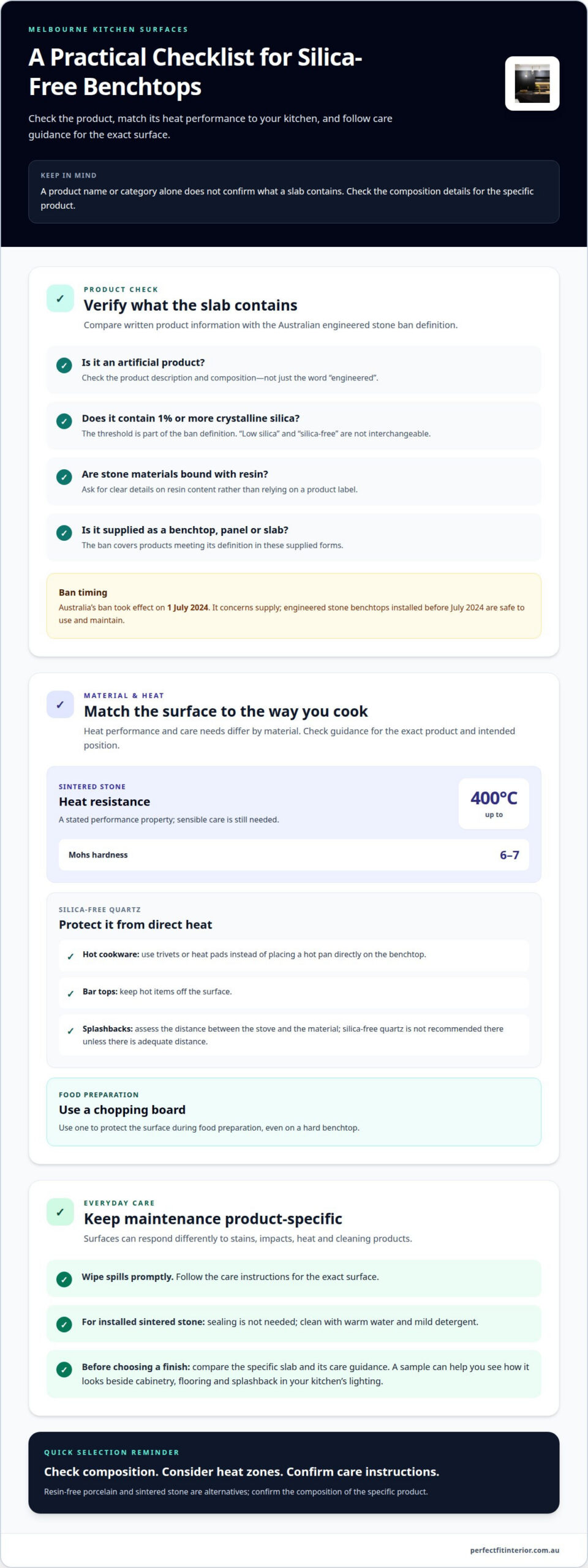
Traditional engineered stone that meets Australia’s ban definition can no longer be supplied as a benchtop. In Victoria, alternatives include resin-free porcelain and sintered stone. Check the composition of the specific product rather than relying on its category or label.
Australian Ban and Silica Threshold
Australia’s engineered stone ban took effect on 1 July 2024. It covers artificial products containing 1% or more crystalline silica that bind stone materials with resin and are supplied as benchtops, panels or slabs. The threshold, resin and product form all matter, so the word “engineered” alone doesn’t determine whether a surface falls within the ban.
Traditional engineered stone commonly contained up to 90 per cent crystalline silica. That figure helps explain why the distinction matters, but it doesn’t identify the composition of every product. Engineered stone installed before July 2024 is safe to use and maintain; the ban concerns supply, not continued use of existing benchtops.
Silica-Free Quartz Composition and Safety
“Silica-free quartz” is a product description, not enough detail by itself to establish what a slab contains. Ask to see product information that identifies crystalline silica content, resin content and the material’s intended use. Compare those details with the Australian ban’s 1% threshold and its definition of covered benchtops, panels and slabs.
Don’t treat “low silica” and “silica-free” as interchangeable. A product containing any crystalline silica is different from one containing none. Check clear composition information to compare surfaces accurately: the name “quartz” alone doesn’t tell you what a product contains.
Silica-Free Product Ranges
Melbourne buyers can consider resin-free porcelain and sintered stone as alternatives. Australia’s ban does not cover sintered stone or porcelain when they contain no resin. The composition of sintered stone and other products depends on their specific materials.
Colours, patterns and finishes vary between product ranges. Compare the specific slab rather than assuming every product in a category looks the same. A sample can help you see how a finish works beside your cabinetry, flooring and splashback in your kitchen’s lighting.
Checking Products Against Banned Stone
Use a simple comparison: identify whether the product is artificial, contains crystalline silica, binds stone materials with resin, and is supplied as a benchtop, panel or slab. The ban applies when the product meets its definition and contains 1% or more crystalline silica. Resin-free porcelain and sintered stone sit outside that definition when they contain no resin.
Compare the product’s written composition details with those criteria, then keep the information with your renovation selections. Melbourne cabinetry planning works best when the chosen slab, cabinetry layout and finish are considered together. A Melbourne cabinet-making service can help coordinate the benchtop decision with the wider kitchen design.
Durability and resistance to scratches, impacts and heat
Durability depends on both the benchtop material and how you use it. Sintered stone and silica-free quartz respond differently to heat, so check the care guidance for the exact surface. Consider where hot cookware can rest and how everyday food preparation may affect the slab, as well as how the finish looks.
Sintered stone offers heat resistance up to 400 degrees Celsius and has a Mohs hardness of 6 to 7. These properties make it a durable option for busy kitchens, though they don’t remove the need for sensible care. Use a chopping board to protect the surface during food preparation, and avoid treating a hardness rating as a guarantee against every impact or scratch.
Silica-free quartz needs extra care around direct heat. Use trivets or heat pads instead of placing a hot pan straight from the cooktop on the benchtop. Protect a bar top from hot items, too. These habits help preserve the finish, especially around busy preparation areas.
Heat exposure also matters when you’re planning a splashback. Silica-free quartz isn’t recommended in this position unless there’s adequate distance between the stove and the surface. Before fabrication, consider the cooktop location, available wall space and intended material. A surface suitable for a benchtop isn’t automatically suitable beside a heat source.
- For hot cookware: use trivets or heat pads on silica-free quartz.
- For preparation: use a chopping board, even on a hard surface.
- For a splashback: assess the gap between the stove and the material.
- For bar tops: keep hot items off silica-free quartz surfaces.
Consider how the surface handles stains and spills in everyday use. Silica-free benchtops may respond differently to stains, impacts and heat, so follow the care guidance for the specific material. Wipe spills promptly and follow the specific product’s cleaning instructions instead of assuming every surface tolerates the same cleaner or treatment.
A showroom sample can help you assess colour and finish, but consider the kitchen’s actual use too. Think about where cooking, serving and food preparation happen, then match those zones to the surface’s heat precautions. For a cohesive layout, Melbourne cabinet-making can be considered alongside benchtop selection and fabrication.
Porcelain slab properties and maintenance
Porcelain, stainless steel, timber and recycled glass all have different care needs. If you want to avoid sealing, installed sintered stone benchtops don’t need it and can be cleaned with warm water and mild detergent. Before choosing a surface for a kitchen or laundry, compare the exact material, finish and care instructions.
Porcelain slabs can create a continuous, polished look across a benchtop, island or splashback. For everyday cleaning, remove crumbs, wipe spills with a soft cloth and use the product’s recommended cleaner. Don’t assume porcelain care instructions also apply to sintered stone, even though both are silica-free alternatives.
Sealing requirements vary between natural stone surfaces. Sealing needs vary between natural stone surfaces, so check the care guidance for the specific material and finish. Factor this recurring maintenance into your comparison with surfaces that don’t need sealing, and follow the care guidance for the specific material and finish.
Stainless steel suits kitchens where a practical, clean-lined surface is the priority, but it can show scratches and marks. Use non-abrasive cloths and avoid dragging cookware across it. Timber brings warmth and natural variation, but needs attentive cleaning and protection from standing moisture. Wipe spills promptly and use chopping boards to limit marks.
Recycled glass adds visible colour and texture, shaped by the glass pieces within the surface. Use gentle cleaning tools and follow the supplier’s care directions to protect the finish. For porcelain, stainless steel, timber or recycled glass, check how the finished surface handles routine cleaning, scratches and everyday kitchen tasks before deciding.
- For porcelain: follow the slab’s care directions and use a soft cloth for routine cleaning.
- For sintered stone: clean with warm water and mild detergent; sealing isn’t needed.
- For granite: plan for annual sealing.
- For marble: account for resealing every six to twelve months.
- For timber or recycled glass: use gentle cleaning and promptly wipe spills.
A laundry benchtop faces different routines from a kitchen island. Detergent splashes, damp clothing and daily folding can affect which finish and cleaning method suit the space. Match the material to how you’ll use it, then follow its care instructions consistently to keep maintenance manageable and help preserve the surface.
Crystalline silica-free mineral surface composition
A surface name doesn’t reveal the full composition. Compare the product’s material details with the properties you need, such as crystalline silica content or a non-porous finish.
Mineral Surface Composition
Zero-silica stone benchtops contain no crystalline silica. That’s different from a product described as “low silica” or given a broad label such as mineral surface. Two slabs with similar stone-like patterns can contain different ingredients. Read the composition details and compare the specific surface, not just its appearance or showroom label.
Non-Porous Hygiene and Solid Surfaces
A non-porous surface may make routine cleaning more straightforward, but stain and hygiene performance can vary by product. That can make routine kitchen cleaning more straightforward, but the surface still needs cleaning. Wipe food or liquid spills and follow the care directions for the particular slab. Even a pale surface near a sink benefits from prompt cleaning.
“Solid surface” is a broad material category, not a single recipe. Composition varies between products, so don’t assume every solid surface contains no crystalline silica or offers the same stain performance. Compare each named product’s material description, intended applications and care guidance before choosing it for a kitchen island, worktop or laundry.
For a practical comparison, separate three questions:
- Composition: Does the product state that it contains no crystalline silica?
- Surface: Is it described as non-porous, and what does that mean for everyday cleaning?
- Care: Which cleaning method is recommended for that specific material?
These details help separate a material’s properties from its appearance. A stone-look pattern doesn’t establish whether a slab is natural stone, a mineral surface or another solid surface product. Likewise, “silica-free” describes crystalline silica content, not stain resistance, heat performance or cleaning requirements. Match each claim to the property it actually describes.
Start with where you’ll use the surface. A benchtop beside a sink gets regular splashes, while an island may be used for food preparation and serving. A non-porous description can inform your hygiene comparison, but the finish, edges and daily use matter too. Compare composition and care separately rather than relying on appearance alone.
Silica-free quartz colours, finishes and slab options
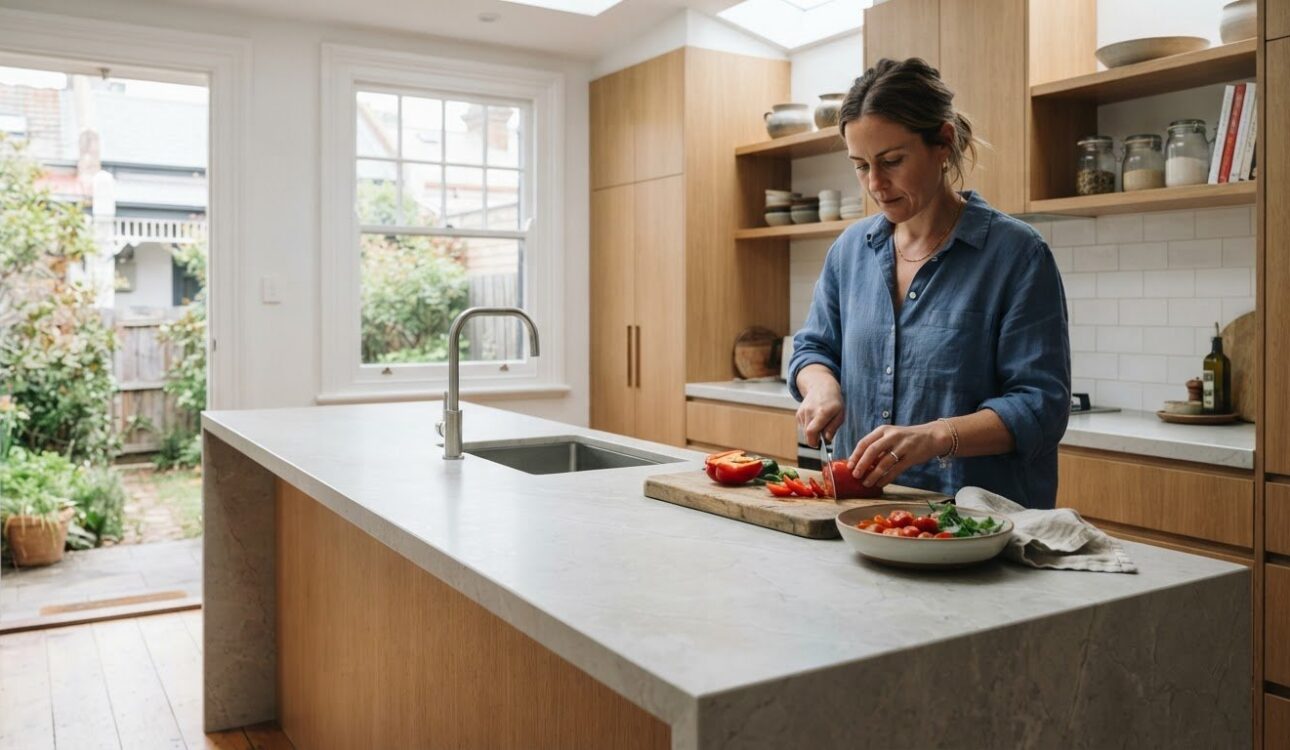
Colour, pattern and finish can be customised for silica-free benchtops, giving you room to coordinate the surface with kitchen cabinetry and flooring. Start with the kitchen’s fixed elements, such as timber cupboards or a tiled splashback, then compare samples against them. A natural stone look can bring visual movement, while a consistent pattern may suit a streamlined design.
Whenever possible, look at the actual slab, not just a small sample. A sample helps you assess colour and texture, while the full slab shows how its pattern varies across a larger area. Picture that pattern on an island, a long worktop or adjoining sections. Factor in your preferences, the room’s lighting and nearby finishes.
Finish affects how colour and pattern appear in the installed kitchen. Compare available finishes in lighting similar to where the benchtop will sit: a showroom surface may look different beside your cabinetry at home. View samples with your flooring and splashback selections before settling on a palette, especially where materials meet at a corner.
Slab dimensions affect how the design translates into fabrication. Measure the kitchen layout accurately, including returns, sink openings and cooktop cut-outs, then compare those measurements with the slab’s stated dimensions. Slab size and benchtop layout influence where joins may sit and how the pattern carries across separate sections.
Thickness and edge details also shape the finished look. Compare the specified slab thickness with your cabinetry and the appearance you want for the island or perimeter. Treat the edge profile as part of the overall design, not a minor finishing detail. Use the product information to establish which thickness and edge treatments suit the material.
Sintered stone has 0 per cent crystalline silica. For any silica-free quartz option, keep composition separate from colour and style claims. A pattern that resembles natural stone describes appearance, not ingredients. Review the selected product’s composition information alongside its available colours, finishes and slab details, so the design choice and material choice both meet your priorities.
- Compare colour: view the sample beside cabinetry, flooring and splashback finishes.
- Check the full slab: assess pattern movement across the planned benchtop sections.
- Plan fabrication: use measured layouts and product dimensions to consider joins and cut-outs.
- Review finishing details: compare stated thickness and edge profiles for the selected material.
For a cohesive layout, coordinate benchtop selections with kitchen renovation planning and cabinetry. A Melbourne cabinet-making service can help bring the material choice into the kitchen design.
Plan your Melbourne kitchen cabinetry
Perfect FIT Interior: Home Renovation
For Melbourne projects where a new benchtop is part of a broader update, Perfect FIT Interior offers home renovations. Once you’ve compared materials, finishes and care requirements, consider how the surface will work with the cabinetry, storage and rest of the room. A coordinated plan brings these choices together in the overall design.
If you’re planning a home or bathroom renovation in Melbourne, Perfect FIT Interior can consider the room’s materials and layout together. Bring your preferred colours, finishes and practical priorities to the discussion to help shape your project.
Contact Perfect FIT Interior to discuss your renovation plans.
Shape a kitchen that feels considered
Turn your preferred look into a practical room plan. Consider how the kitchen connects with adjoining spaces, where you need clear preparation areas and which details you want to stand out. Bringing these priorities together helps the benchtop feel integrated into the design, rather than added as an afterthought.
As you plan Silica-Free Kitchen Benchtops Melbourne homeowners can choose from, use your shortlist to guide decisions about cabinetry, lighting and layout. Seeing these elements together helps you judge whether the design feels balanced and suits how you’ll use the room. Keep your priorities clear as you plan the renovation.
Ready to make a practical plan? Contact Perfect FIT Interior to discuss your home renovation and how your benchtop choice can work with the room.
With a clear direction, you can create a kitchen that feels distinctly yours.
Frequently Asked Questions
Want to transform the look of your space and looking for Zero Silica Benchtops?
Yes. A zero-silica benchtop keeps crystalline silica out of the surface while giving your kitchen a fresh look. Choose a material and colour that suit your cabinetry, then consider how the slab will meet the sink, cooktop and adjoining work areas. A coordinated sample board can help you assess the overall effect before settling on a design.
Can I customise these benchtops?
Yes, silica-free benchtops can be customised by colour, pattern and finish. You could choose a natural-stone look with a subtle pattern or a more uniform finish to complement plain cabinetry. Compare samples in the room’s lighting and alongside its fixed finishes. The slab’s stated dimensions and fabrication requirements also affect how the pattern appears across an island or connected work surfaces.
How much do silica-free benchtops cost in Melbourne?
The price depends on the material, slab dimensions, edge details, cut-outs, fabrication and installation. A sink opening or an island with several finished edges can affect the work involved. To compare options, define the layout and preferred material first, then assess the selected slab and finishing details as part of the overall renovation scope.
Why choose silica-free surfaces?
Silica-free surfaces offer an option for anyone looking for a benchtop without crystalline silica. They also provide different choices in material appearance, colour and finish, so you aren’t limited to one stone-like look. Compare a patterned slab with a plain finish, then weigh each against your cooking habits, preferred cleaning routine and kitchen style.
What can you choose instead of engineered stone?
Alternatives include resin-free sintered stone and porcelain products. Natural stone is another option, with its own appearance and maintenance requirements. Compare the exact product composition and care instructions rather than relying on a category name. Weigh the surface’s appearance, upkeep and intended use against your kitchen layout and design priorities.
What does the ban actually cover?
Since 1 July 2024, Australia’s engineered stone ban restricts the supply of artificial products containing 1% or more crystalline silica, bound with resin, and supplied as benchtops, panels or slabs. The threshold, resin and product form all matter. Sintered stone and porcelain are outside the ban when they contain no resin. The rule concerns supply, not ordinary use of previously installed benchtops.
What silica-free kitchen benchtop materials are available in Melbourne?
In Melbourne and across Victoria, buyers can consider resin-free sintered stone and porcelain, alongside products marketed as silica-free quartz or mineral surfaces. A product label alone doesn’t establish its composition. Compare each slab’s material details, available finishes and maintenance guidance to judge both its appearance and suitability for food preparation and everyday kitchen tasks.
Which Melbourne suppliers and fabricators offer silica-free benchtops?
Perfect FIT Interior offers Kitchen Renovation Melbourne, bringing benchtop choices into the wider consideration of cabinetry and layout. This connects the surface decision with the overall design instead of treating it as an isolated finish. Compare product composition and care information as you plan a kitchen around your household’s needs. Contact Perfect FIT Interior to discuss your renovation.
Disclaimer
All right reserve for Perfect Fit Interior – InnovateX Group PTY LTD